Merchant hub. A discovery layer for agent-ready merchants.
Merchant Hub · Applied groundwork
The gap
Shopping agents need a reliable way to find merchants that can answer and complete an agent-led purchase. That discovery layer was missing. We built Merchant Hub as a directory and registry for agentic commerce: a place where agents can find relevant merchants, understand their capabilities and connect to the right endpoint.
What we built
Merchant Hub brings merchant onboarding, domain verification, structured capabilities, natural-language discovery and operational monitoring into one working application. Merchants describe what they sell and which protocols they support. Agents search through REST or MCP by intent, category and capability. The Hub makes the introduction; the transaction remains directly between the agent and merchant.
How it works
A merchant enters the registry, verifies its domain and publishes structured information about its business, markets and agent-facing capabilities. Merchant Hub enriches and indexes that information so an agent can ask for a need such as shoes and receive relevant merchant destinations instead of searching a general list by name.
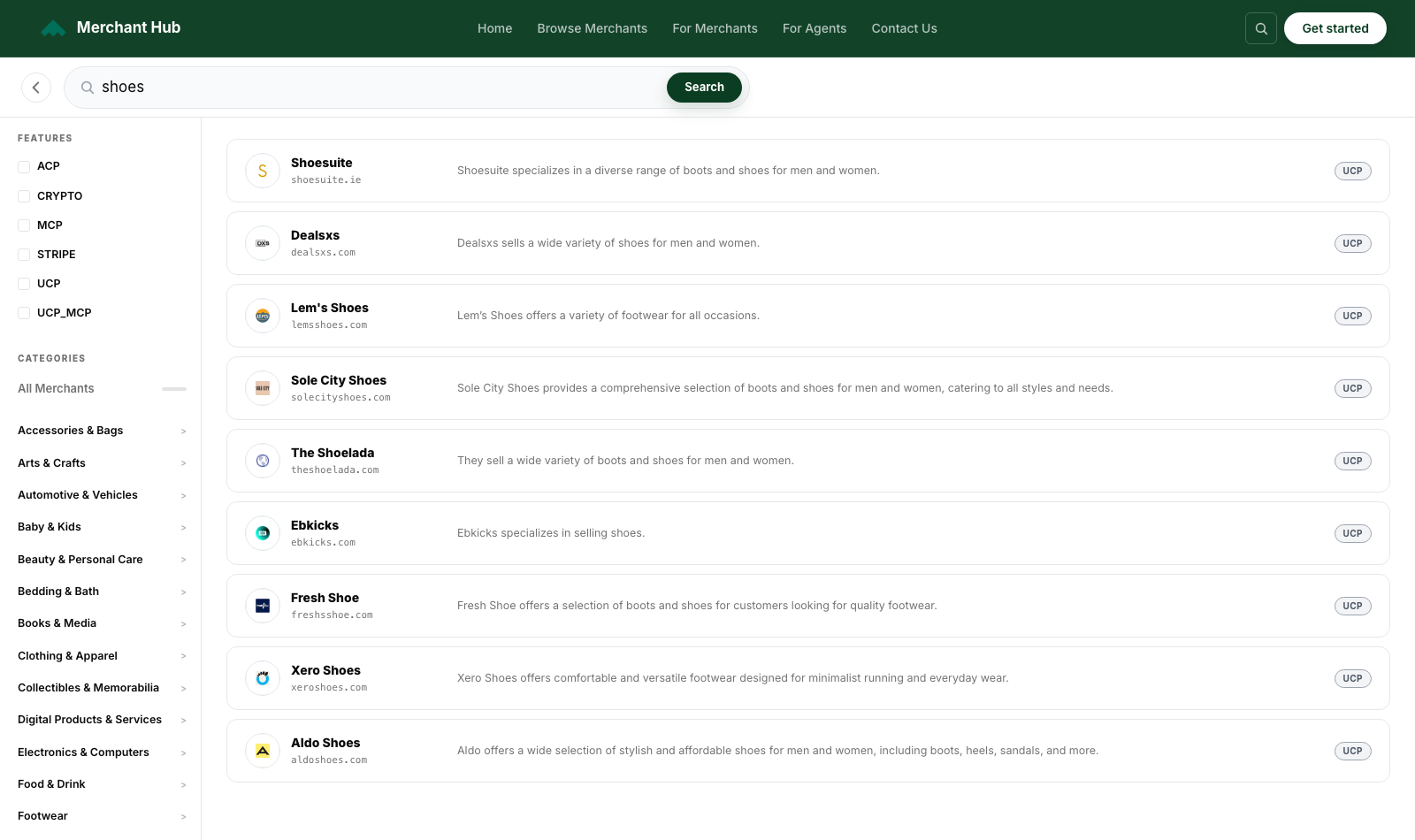
What the working application proves
A shopping intent can be translated into a useful set of real merchant destinations. The same discovery can be accessed visually through the directory or programmatically through REST and MCP, with filters for category and supported protocols including UCP and ACP.
Keeping discovery dependable
Being listed is not enough. A destination that cannot respond should not remain a trusted option for an agent. Merchant Hub continuously checks merchant health and preserves that operational signal alongside discovery, helping agents avoid relying on destinations that are no longer available.
How this helps our clients
Building the full discovery lifecycle showed us what a merchant must publish beyond a conventional storefront: verified identity, clear taxonomy, machine-readable capabilities, working endpoints and evidence that those endpoints remain healthy. We use that groundwork when assessing and preparing retail systems for agent-led commerce.